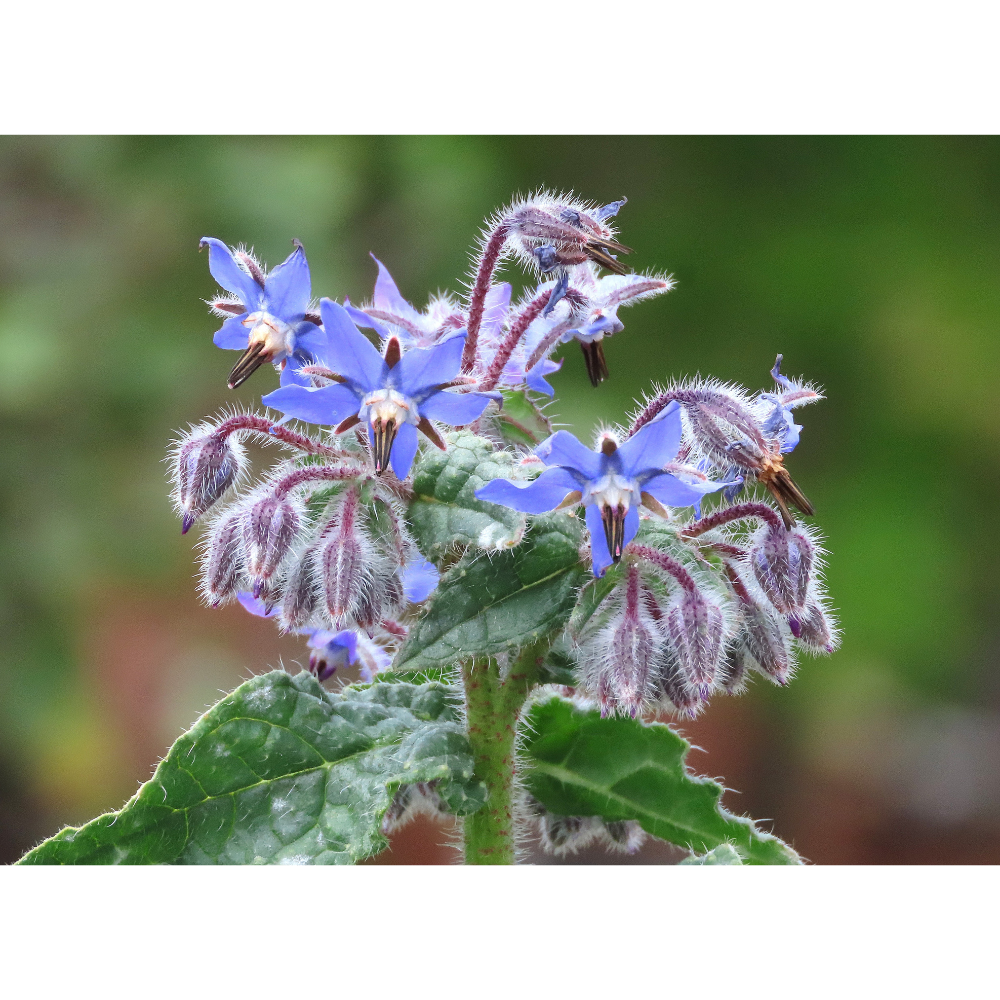
Herbal Tidbit: Borage
Common Name: Borage
Scientific name: Borage Officinalis
Other names: Star Flower, Bee Bread, Burrage, Herb of Gladness
Botanical Description: A short-lived hardy annual, 2 – 3 ft (60 – 90 cm) high, hollow, hairy stems, downy leaves, branching habit. Blue (sometimes pink) flowers, star-shaped with black centres. Prefers a sunny location and well-drained soil and easy to propagate from seed. Self-sows freely.
Native Habitat: Mediterranean region from Spain to Turkey. Naturalized in Europe and many other parts of the world.
History: It was eaten or worn for courage by soldiers and medieval knights. It was also said to bring happiness and dispel melancholy and heartbreak.
Everyday uses: Stem and leaf are mildly cucumber flavoured. Young leaves can be used in cold drinks and finely chopped in sandwiches and salads. The flowers can also be eaten in salad or candied/dried for sweet dishes and cakes. They attract bees to the garden. If planted near tomato plants, may control tomato worm. Planted near strawberries, they stimulate each other’s growth.
Herbalism uses: The leaves are used. It is cooling and anti-inflammatory so it can be used as a poultice for bruises and to soothe inflamed skin. It’s also a diuretic and a mild antidepressant. The oil made from its seeds is a good substitute for evening primrose oil as they both contain gamma-linolenic acid. The oil is used in pharmaceutical drugs and cosmetics
Magickal uses and correspondences:
Planet(s): Jupiter
Astrological Signs: Sagittarius, Pisces
Element: Air
Magickal uses: Risk-taking, bravery, fearless courage, psychic powers
Sources:
Bremness, Lesley. The Complete Book of Herbs. Viking Studio Books, 1988.
Houdret, Jessica. Practical Herb Garden: A comprehensive A-Z directory and gardener’s guide to growing herbs successfully. Hermes House, 2003.
Harrington, Christina Oakley. The Treadwell’s Book of Plant Magic. Red Wheel/Weiser Books, 2023.
Cunningham, Scott. Cunningham’s Encyclopedia of Magical Herbs. Llewellyn Publications, 2014.