Tarot Overview
This Tarot overview covers its history and its components. We’ll get more into the nitty gritty as this series progresses. The precise origin of Tarot cards is not known but it is widely believed to be derived from a game from the 1300s. Tarot started to be used as a divinatory tool in the 1700s (could have been earlier) but gained greater popularity in the 20th century.
A standard Tarot pack has 78 cards. The are two major sections – the Major Arcana and the Minor Arcana. The Major Arcana numbered 0 – 21, make up 22 of the cards. The Major Arcana are archetypal in nature and illustrate major stages in an individual’s spiritual journey. The names and relative themes of each card are as follows (in some decks the positions of the Strength and Justice cards may be flipped):
|
0 – The Fool: New Beginnings |
1 – The Magician: Power, Alchemist |
|
2 – The High Priestess: Intuition |
3 – The Empress: Fertility, creativity |
|
4 – The Emperor: Leadership |
5 – The Hierophant: Tradition |
|
6 – The Lovers: Choice, partnership |
7 – The Chariot: Movement, victory |
|
8 – Strength: Strength, compassion |
9 – The Hermit: Introspection |
|
10 – The Wheel of Fortune: Fate |
11 – Justice: Balance, fairness |
|
12 – Hanged Man: Waiting |
13 – Death: Endings, Rebirth |
|
14 – Temperance: Moderation, balance |
15 – The Devil: Temptation, Vices |
|
16 – The Tower: Abrupt change |
17 – The Star: Healing, hope |
|
18 – The Moon: Secrets, Reflection |
19 – The Sun: Truth, happiness |
|
20 – Judgement: Clarity |
21 – The World: Completion |
The Minor Arcana make up 56 of the cards and is split into 4 suits with court cards just like a playing card deck – Cups/Hearts, Pentacles/Diamonds, Swords/Spades, and Wands/Clubs. In each suit there are ten numbered cards (1 – 10) and 4 court cards: Page, Knight, Queen, King.
Tarot Overview
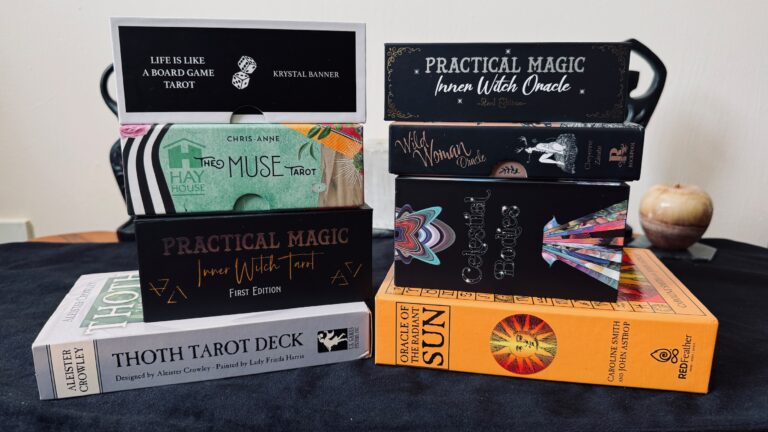
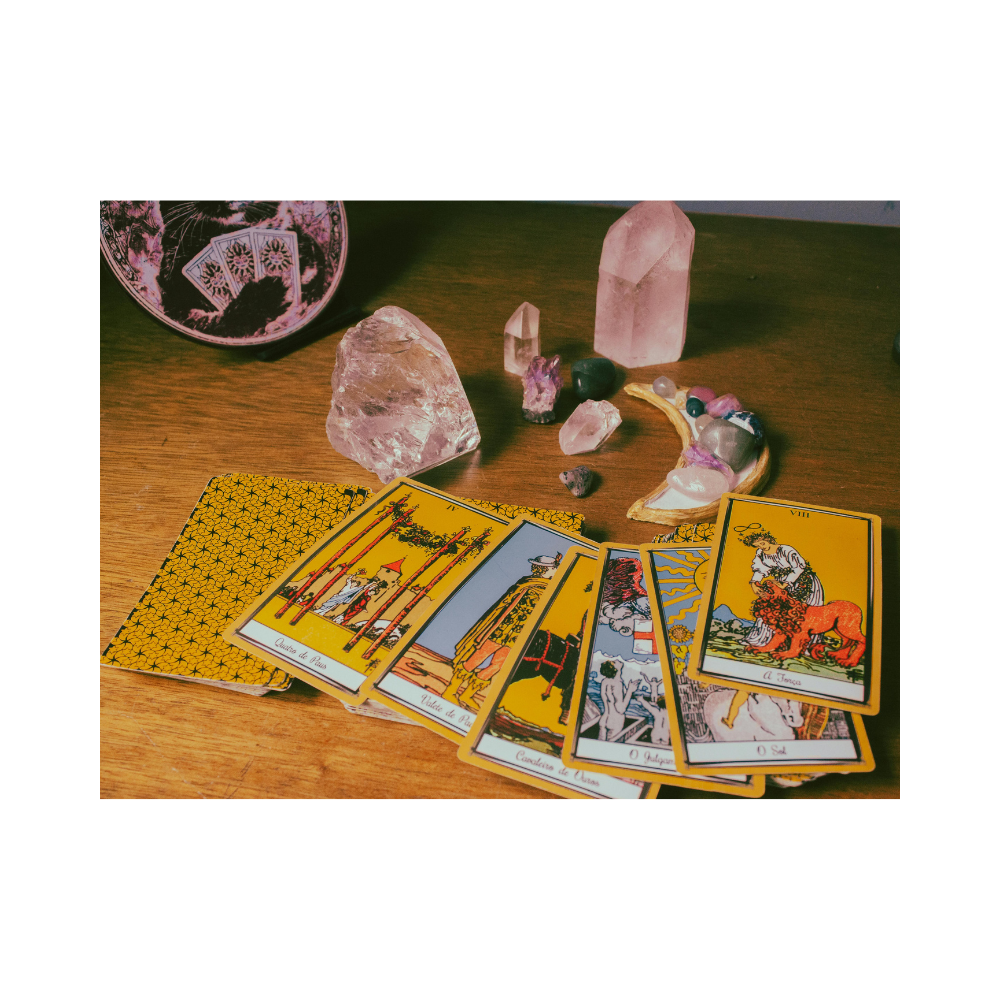
Modern Tarot decks are based on three main schools of thought: Rider-Waite-Smith/RWS, Crowley/Thoth, and Marseilles (refers to the iconographic style not the place). The Rider-Waite-Smith Tarot deck was created by Arthur Edward Waite and painted by Pamela Colman Smith in 1909. This deck was widely printed and distributed so it has been the basis of many modern Tarot decks since then. Aleister Crowley and Lady Frieda Harris created and painted the Thoth deck in the 1940s. Jean-Baptiste Alliette, an occultist who went under the pseudonym Etteilla, in the 1700s popularized the form of Marseilles Tarot seen in Modern decks. All these decks include elements of the systems of mysticism, Kabbalah/Qabalah, Western astrology, numerology, and Greek, Roman and Egyptian mythology.
Currently, Tarot decks vary according to the creator’s choice to stick to one of the above schools of thought or deviate from them in one way or another. Creators infuse their own views, perspectives and understanding of the cards to their decks. It is up to the buyers to do some research into whether or not the deck will resonate with them.
When first getting into Tarot, it may be helpful to buy a deck based on the RWS deck since the majority of resources (books included) rely on that deck as an educational tool. Once you’re familiar with the concepts, feel free to venture out and explore the wide variety of decks out there. Most decks include a guidebook as well. The amount of information contained in the guidebooks varies widely but can be helpful in figuring out the creator’s intent in the making of the deck. In making your decision, take note of the art style, the size of the cards, the theme, and any reviews it may have gotten.
A lot of resources will recommend making a Tarot journal to go along with your studies on the Tarot. The idea behind it being that once you’ve mastered the basics, you will begin to uncover your own ways of interpreting the cards and the journal is a way to document those discoveries. Over the years, I have found using the cards regularly, if not daily, helps you form a personal relationship with the cards and their meanings for you.
A few books to get you started:
Wen, Benebell. Holistic Tarot: An integrative approach to using Tarot for personal growth. North Atlantic Books, 2015.
Pollack, Rachel. Seventy-Eight Degrees of Wisdom. Weiser Books, 2007.
Huggens, Kim. Tarot 101: Mastering the art of reading the cards. Llewellyn Publications, 2014.
Antenucci, Nancy. Psychic Tarot: Using your natural psychic abilities to read the cards. Llewellyn Publications, 2014.
DuQuette, Lon Milo. Understanding Aleister Crowley’s Thoth Tarot. Weiser Books, 2003
What are some of your favourite Tarot decks?