Tarot vs. Oracle Decks
What are the differences between Tarot and Oracle decks?
My first introduction to Tarot was over 20 years ago when I would occasionally go and receive readings at psychic fairs run by a local New Age bookstore. At the time, I thought it was cool that the reader used them to try to give me information I might need but I didn’t think that I would use them personally.
About five years after that initial contact, I was going through a major period of spiritual re-awakening, a dark night of the soul. I was trying to work out what I truly believed in. I was heavy into the products of one of the spiritual publishing companies at the time, so I purchased some oracle decks. I was a little intimidated by Tarot back then and felt more connected to the oracle decks because there wasn’t a system I had to learn to use them. About a year later, I bought my first Tarot deck after watching a variety of videos on YouTube. I haven’t looked back since.
Everyone uses and views Tarot decks and oracle decks differently. For me, both Tarot and oracle decks are wonderful divinatory tools for self-exploration and spiritual development. I use them to connect to, focus and hone my intuition. I also use them as confirmation of the channeled messages I’m receiving from my Higher Self, my Spirit Team, and Divine Intelligence/Universe. I don’t use them to foretell the future. The closest thing to predictive is using them as a guides to see potential themes or situations that may come up either in the week ahead or in the weeks after a New or Full moon. Now for the differences.
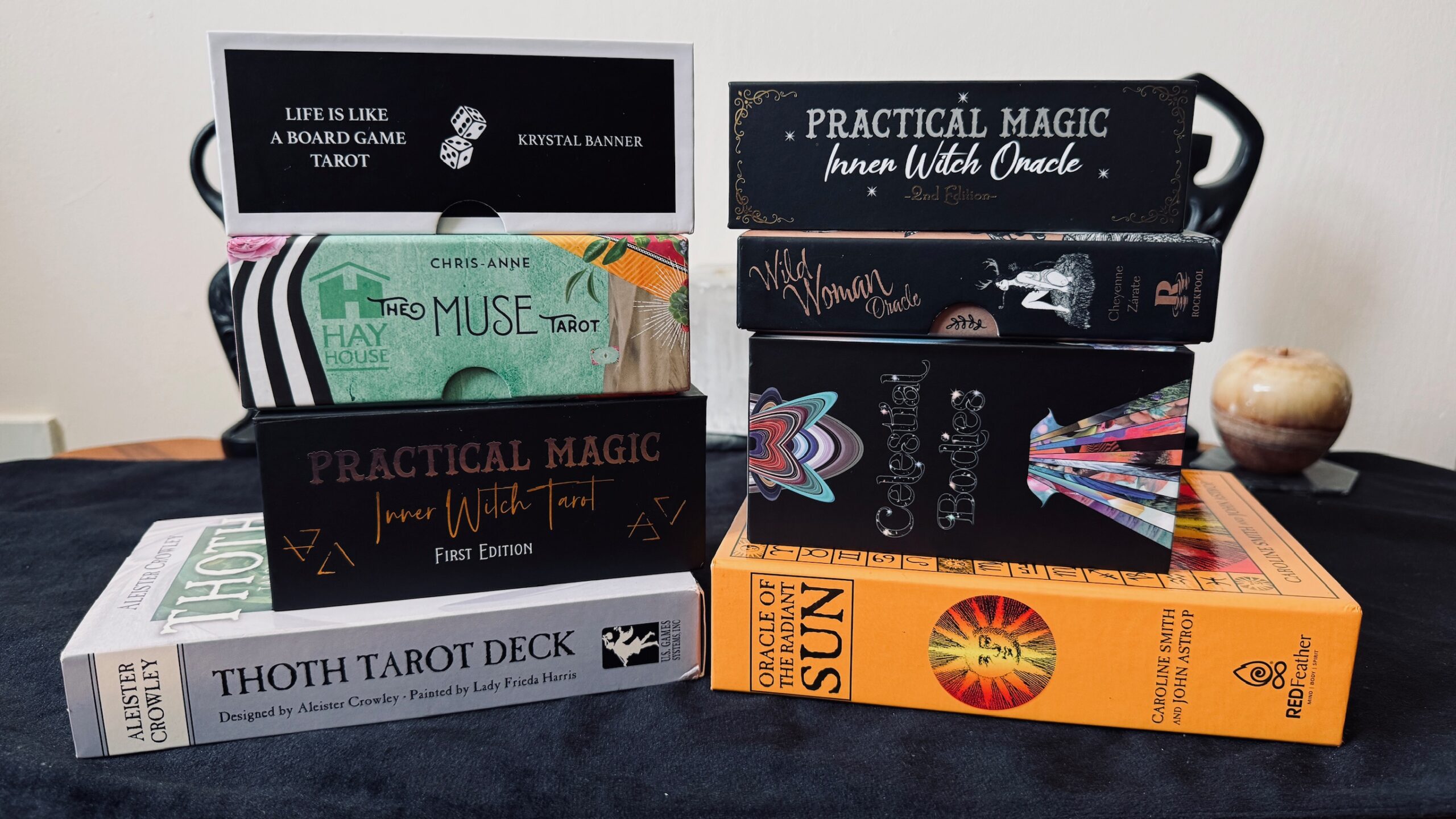
Tarot decks are usually modelled after three main schools of thought: Rider, Waite, Smith/RWS; Crowley/Thoth; and Marseilles (not the place… and one of the oldest forms). The RWS deck, created in 1910, was widely printed and distributed the most so it has since been the basis of many modern Tarot decks. A standard Tarot pack consists of 78 cards. 56 of the cards are the Minor Arcana and 22 cards are the Major Arcana. The Minor Arcana is split into 4 suits with court cards like a playing card deck – Cups, Pentacles, Swords, Wands. The Major Arcana, numbered 0 – 21, are archetypal in nature and illustrate major stages in an individual’s spiritual journey. See this post for more information on Tarot.
Oracle decks are not based on a universal system. The amount of cards in an oracle deck vary widely. The decks are whatever their creator intended them to be. They can be specifically themed in both visuals and content. There are deity decks, love and relationship decks, self-love decks, astrology decks, career decks, or decks that cover the full spectrum of human life. The choices are endless. They can be used as clarifiers in a Tarot reading or in a stand-alone reading of their own. Creators often include different card spreads that can be used with the deck in the guidebooks that often accompany the deck (Tarot deck creators also provide this as well).
There are some who have never used an Oracle deck, only Tarot and there are those who have only used Oracle deck and have never used Tarot. I like to use both with emphasis on oracle decks. Ultimately, the choice of deck is up to the individual. I like to say try everything at least once – you never know, you might like it. Reading the description or intention the creator of a deck provides might be helpful to see if it would be a deck that might resonate with you. Looking at any images provided might also help. Use your intuition to guide you. Who knows? You might like it.